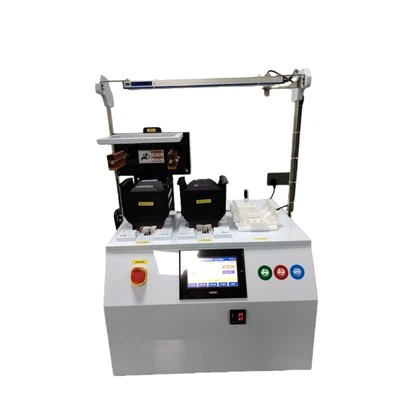
Hey there! As an ICP Etcher supplier, I'm often asked about how key components work-and one of the most common questions is about bias voltage. Let me break it down in straightforward terms.
ICP Etchers are widely used in semiconductor and microfabrication. They generate high-density plasma to etch precise patterns on silicon wafers for chips used in smartphones, computers, and other electronics.

Bias voltage is one of the most critical parameters in the process. Simply put, it's the voltage applied to the substrate holder where the wafer sits.
Its main job is to control the energy and direction of ions in the plasma. The RF coil generates plasma inside the chamber, but ions inside move randomly without guidance. When bias voltage is applied, an electric field forms and accelerates positive ions toward the wafer vertically. This enables anisotropic etching-straight, vertical sidewalls that are essential for high-precision integrated circuits.
Bias voltage also directly affects etch rate. Higher bias means higher ion energy, which breaks material bonds faster and speeds up etching. But too high a bias can cause issues: over-etching, surface roughness, or even substrate damage. Finding the right balance is essential.
In addition, bias voltage influences etching selectivity. By adjusting bias, we can favor etching one material over another. For example, proper bias settings allow silicon dioxide to be etched much faster than the underlying silicon, improving process selectivity.

We offer a range of reliable etching solutions, including our 8" ICP Etcher with precise bias control for stable, repeatable results. We also provide a Reverse Beam Shaping System that works with bias voltage to further optimize ion distribution and etching uniformity. For different process needs, we also supply RIE Etchers, which use similar bias control mechanisms.
The ideal bias voltage depends on your material type, film thickness, and target feature size. We always recommend starting with lower bias and fine-tuning through process tests, using SEM to verify profile quality.
In short, bias voltage is central to controlling ion energy, etch rate, directionality, and selectivity in ICP etching.
If you're looking for reliable ICP etching equipment or need help optimizing your process parameters, feel free to contact us. Whether you're a research lab or a high-volume manufacturer, we can provide a tailored solution for your production needs.
Another important aspect of the bias voltage is that it can control the etching rate. By increasing the bias voltage, we effectively increase the energy of the ions hitting the substrate. When the ions have more energy, they can break the chemical bonds in the material on the wafer more easily, which means a faster etching rate. But it's not all about going full - throttle. If we set the bias voltage too high, it can cause some problems. For example, it might lead to over - etching, where we end up removing more material than we intended. It can also cause damage to the substrate surface, like creating rough or uneven areas. So, finding the right balance is key.
The bias voltage also plays a role in the selectivity of the etching process. Selectivity is all about the ability to etch one material while leaving another one relatively untouched. Different materials have different bonding energies, and by adjusting the bias voltage, we can target specific materials more effectively. For instance, if we're trying to etch a layer of silicon dioxide on top of a silicon substrate, the right bias voltage can help us etch the silicon dioxide at a much faster rate than the silicon, giving us good selectivity.
Now, I want to mention some of the products we offer as an ICP Etcher supplier. We've got the 8" ICP Etcher, which is a great option for those working with 8 - inch wafers. It's designed to be highly efficient and precise, with advanced controls that allow you to fine - tune the bias voltage and other parameters for optimal results.
We also have the Reverse Beam Shaping System, which works in tandem with the bias voltage to further enhance the etching process. This system helps in shaping the ion beam, making sure that the ions hit the substrate in the most effective way possible.
And if you're looking for something a bit different, we also offer the RIE Etcher. While it's a bit different from the ICP Etcher, it also uses bias voltage in a similar way to control the etching process.
So, how do you know what bias voltage to use? Well, it depends on a bunch of factors. The type of material you're etching is a big one. Different materials have different properties, so they'll require different bias voltages for the best results. The thickness of the layer you're etching also matters. Thicker layers might need a higher bias voltage to etch through in a reasonable amount of time. And the desired feature size and shape on the substrate are important too. If you're going for really small, precise features, you'll need to be extra careful with the bias voltage to avoid over - etching.
In most cases, it's a good idea to do some test runs. Start with a lower bias voltage and gradually increase it while monitoring the etching process. You can use tools like SEM (Scanning Electron Microscopy) to check the quality of the etched features. This way, you can find the sweet spot for your specific application.
In conclusion, the bias voltage is an incredibly important part of an ICP Etcher. It controls the energy and direction of the ions, affects the etching rate, and plays a key role in the selectivity of the process. And as a supplier, we're here to help you make the most of it. Whether you're a small - scale lab or a large - scale manufacturing facility, we've got the right ICP Etcher and support to meet your needs.
If you're interested in learning more about our ICP Etchers or want to discuss your specific requirements, don't hesitate to reach out. We're always happy to have a chat and help you find the perfect solution for your etching needs. Start the conversation today and let's take your semiconductor manufacturing to the next level!
References
- "Semiconductor Device Fundamentals" by Robert F. Pierret
- "Plasma Etching: An Introduction" by J. J. Cuomo, L. J. Mahoney, and R. A. Levy