


Your Professional PVD Equipment Supplier
Nice-tech is a professional semiconductor equipment provider with a dedicated factory and an experienced technical team. Our operations are supported by multiple production lines equipped with standardized process control and key semiconductor-related equipment to ensure stable quality and delivery. The company is backed by a skilled team of engineers, technicians, and project specialists with solid industry experience, enabling effective coordination between equipment suppliers and end users.
-
![IBD System]() IBD SystemThis Ion Beam Deposition Equipment is a high-precision thin film deposition system designed for the preparation of metal wire and ohmic contact thin films in infrared device manufacturing.view more
IBD SystemThis Ion Beam Deposition Equipment is a high-precision thin film deposition system designed for the preparation of metal wire and ohmic contact thin films in infrared device manufacturing.view more -
![Dual-Chamber Magnetron Sputtering System]() Dual-Chamber Magnetron Sputtering SystemThis dual-chamber magnetron sputtering system is built specifically for infrared focal plane device manufacturing. Its main function is to deposit ZnS/CdTe composite passivation films on HgCdTe epitaxial layers, a critical step in the...view more
Dual-Chamber Magnetron Sputtering SystemThis dual-chamber magnetron sputtering system is built specifically for infrared focal plane device manufacturing. Its main function is to deposit ZnS/CdTe composite passivation films on HgCdTe epitaxial layers, a critical step in the...view more -
![Carbon Magnetron Sputtering System]() Carbon Magnetron Sputtering SystemOur carbon film sputtering equipment is a dedicated system built for depositing high-temperature carbon film protective layers on SiC devices. It uses a cluster architecture that can be configured with multiple process chambers, and...view more
Carbon Magnetron Sputtering SystemOur carbon film sputtering equipment is a dedicated system built for depositing high-temperature carbon film protective layers on SiC devices. It uses a cluster architecture that can be configured with multiple process chambers, and...view more -
![Magnetron Sputtering System]() Magnetron Sputtering SystemThis magnetron sputtering system is built for metal thin film deposition in semiconductor manufacturing. It’s widely used in integrated circuits, power devices, and advanced packaging.view more
Magnetron Sputtering SystemThis magnetron sputtering system is built for metal thin film deposition in semiconductor manufacturing. It’s widely used in integrated circuits, power devices, and advanced packaging.view more -
![MBE System]() MBE SystemOur Molecular Beam Epitaxy (MBE) system is a high-precision epitaxial growth equipment dedicated to compound semiconductor materials, especially ultra-thin heterostructure materials. It is mainly used in the manufacturing of...view more
MBE SystemOur Molecular Beam Epitaxy (MBE) system is a high-precision epitaxial growth equipment dedicated to compound semiconductor materials, especially ultra-thin heterostructure materials. It is mainly used in the manufacturing of...view more -
![Ion Beam Deposition System]() Ion Beam Deposition SystemNice-Tech’ 8-inch IBD system is specialized for low-temperature, high-density, and high-uniformity thin-film deposition on 8-inch wafers. It uses sputtering technology with a dual-ion-source setup (sputtering + assist source): the main...view more
Ion Beam Deposition SystemNice-Tech’ 8-inch IBD system is specialized for low-temperature, high-density, and high-uniformity thin-film deposition on 8-inch wafers. It uses sputtering technology with a dual-ion-source setup (sputtering + assist source): the main...view more -
![Resistance Evaporation Systems]() Resistance Evaporation SystemsNice-Tech’s resistance evaporation systems are purpose-built PVD gear for high-quality thin-film deposition—two core models to cover your needs: the RES 100 and RES 200I.view more
Resistance Evaporation SystemsNice-Tech’s resistance evaporation systems are purpose-built PVD gear for high-quality thin-film deposition—two core models to cover your needs: the RES 100 and RES 200I.view more -
![Electron Beam Evaporator]() Electron Beam EvaporatorThis Wafer Scrubber is a true workhorse—handles 6-inch to 12-inch wafers, and fits right into both wafer fabrication and advanced packaging workflows.view more
Electron Beam EvaporatorThis Wafer Scrubber is a true workhorse—handles 6-inch to 12-inch wafers, and fits right into both wafer fabrication and advanced packaging workflows.view more -
![Magnetron Sputtering Equipment]() Magnetron Sputtering EquipmentOur company’s three Magnetron Sputtering Equipment, based on PVD technology, all deposit high-quality metal, dielectric, and semiconductor films, but differ in application focus.view more
Magnetron Sputtering EquipmentOur company’s three Magnetron Sputtering Equipment, based on PVD technology, all deposit high-quality metal, dielectric, and semiconductor films, but differ in application focus.view more


why choose us
Tailored Solution Delivery
Our experienced team analyzes clients' specific needs to match the most suitable semiconductor equipment and offer customized solutions for different production and R&D scenarios.
Comprehensive Technical Support
We provide full-cycle technical assistance, from equipment commissioning to maintenance, including on-site troubleshooting and real-time online consultation, reducing operational hassles.
Support for Advanced Processes
We continuously invest in industry insights and adapt to cutting-edge tech trends, offering high-precision equipment solutions and upgrading services to meet high-end chip production needs.
Service Advantages
Offer 1v1 online support for equipment operation, parameter adjustment, and process optimization, responding to your questions promptly.
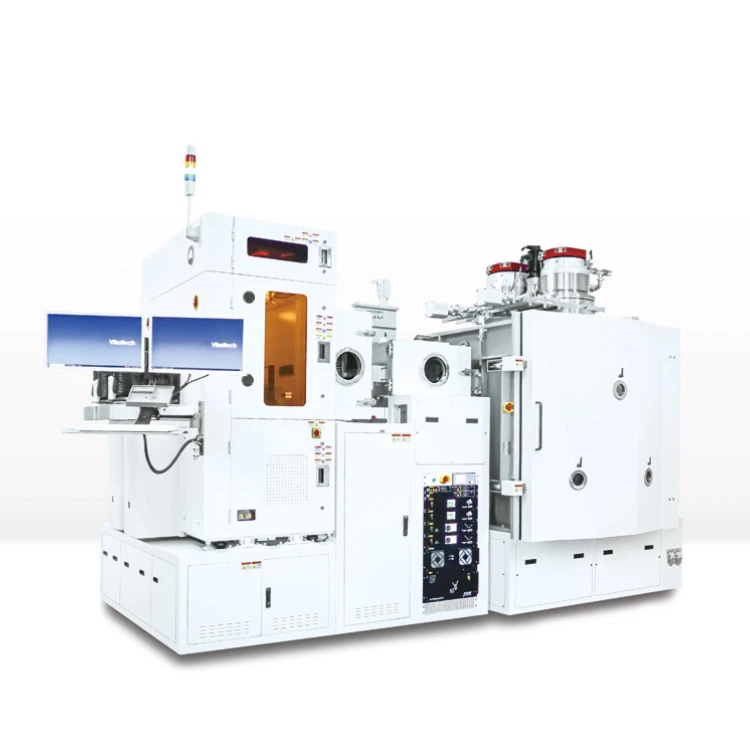
An electron beam (e-beam) evaporator is a high-precision vacuum deposition system widely used in the fabrication of thin films across advanced technological fields. It operates by focusing a high-energy electron beam onto a source material (typically metals, dielectrics, or semiconductors) contained in a water-cooled copper crucible. The intense heat generated by the electron beam causes the material to vaporize, and the vapor then condenses onto a substrate—such as a silicon wafer or optical component—forming a uniform, ultra-thin film.
|
Item |
EBE 700 (High-End Mass Production Type) |
EBE 600/ EBE 600P (Production Dual-Chamber Type) |
EBE 500 (Universal Dual-Chamber Type) |
EBE 400 (R&D Dual-Chamber Type) |
EBE300 /EBE 300P (Production Single-Chamber Type) |
EBE 200 /EBE 200P (Universal Single-Chamber Type) |
EBE 100 (Compact Type) |
|
Coating Uniformity |
±2% |
±3% |
|||||
|
Coating Repeatability |
±2% |
||||||
|
Ultimate Vacuum |
2E-5Pa |
1E-5Pa |
1E-5Pa |
1E-5Pa |
2E-5Pa |
1E-5Pa |
1E-5Pa |
|
Temperature Control Range |
RT ~ 200℃ |
RT ~ 300℃ |
RT ~ 500℃ |
RT ~ 500℃ |
RT ~ 300℃ |
RT ~ 500℃ |
-50℃ ~ 500℃ |
|
Uniform Deposition Area |
Wafer-Level (8-inch & Above for Mass Production) |
Large-Size Workpieces (≤1000mm × 1000mm) |
Universal Size (Suitable for Production & R&D) |
Small-to-Medium Batch Workpieces (R&D & Small-Scale Production) |
Large-Size Workpieces (≤1000mm ×1000mm) |
Maximum Ø300mm (Wafer/Workpiece) |
Laboratory-Scale Small Size (≤Ø150mm ) |
|
Chamber Type |
Single Chamber (Wafer-Level Fully Automatic) |
Dual Chamber (Production Type, Independent Process Chamber) |
Dual Chamber (Universal Type, Mutual Load Lock) |
Dual Chamber (R&D Type, Upper-Lower Chamber Load Lock) |
Single Chamber (Production Type, Large Chamber) |
Single Chamber (Universal Type, Standard Chamber) |
Single Chamber (Compact Type, Small Chamber) |
|
Loading System |
Automatic Wafer Transfer |
Automatic Robot Transfer |
Single/Multi-Wafer Automatic Load Lock |
Single/Multi-Wafer Automatic Load Lock |
Automatic Robot Transfer |
Manual/Semi-Automatic Loading |
Manual Loading (Portable) |
|
L×W×H(m) |
8.5×5.5×3.3 |
4.4×4.1×2.6 |
4.0×3.1×2.9 |
3.0×2.5×2.2 |
4.05×3.9×2.8 |
3.35×2.8×2.2 |
3.15×2.4×2.2 |
|
Net Weight (Approx.) |
12000kg |
8500kg |
6800kg |
4200kg |
7200kg |
5500kg |
3800kg |
Features of Electron Beam Evaporator
High Purity Deposits
The electron beam heats the source material in a high-vacuum environment, minimizing contamination from atmospheric gases or crucible reactions. This results in exceptionally pure thin films with superior electrical conductivity, optical clarity, and mechanical integrity.
Precision and Control
Integrated systems such as mechanical shutters and quartz crystal monitors (QCM) allow real-time monitoring and control of deposition parameters, ensuring consistent film thickness and uniformity.
Versatility in Material Deposition
E-beam evaporators can deposit a wide array of materials due to the high energy density of the electron beam, which can melt even refractory metals and dielectrics.
High Evaporation Rates
The concentrated electron beam delivers intense localized heating, enabling rapid evaporation of materials—ideal for depositing thick films efficiently.
Load Lock Chamber Integration
A load lock chamber allows substrates to be introduced or removed without breaking the main chamber’s vacuum, significantly reducing pump-down time and contamination risk.
Applications of Electron Beam Evaporator
Electronics:
Used for creating interconnects, capacitors, and protective layers in integrated circuits and display technologies.
Optics:
Enables production of precision anti-reflective, high-reflective, and beam-splitting coatings for lenses, lasers, and sensors.
Aerospace:
Deposits wear-resistant and thermal barrier coatings on turbine blades and satellite components.
Medical devices:
Applies biocompatible coatings on implants and diagnostic tools.
Components of Electron Beam Evaporator
Vacuum Chamber
The vacuum chamber plays a critical role in the electron beam evaporation process. It maintains a high-vacuum environment, typically at pressures as low as 7.5×10⁻⁵ Torr. This vacuum condition is crucial because it minimizes contamination and allows the electron beam to travel unimpeded from the electron gun to the source material. The vacuum chamber ensures that the deposited films achieve high purity and uniformity.
Electron Beam Source
Electron beam source, often referred to as the electron gun, generates the high-energy electron beam necessary for the evaporation process. It comprises a cathode, an anode, and a heated filament. By applying a voltage across the cathode and anode, the system produces and focuses the electron beam onto the source material. This focused beam provides the energy required to heat and vaporize the material.
Crucible
The crucible holds the source material that will be evaporated. In some systems, the material is placed directly in a water-cooled copper hearth or within a crucible. The electron beam heats the material to its boiling point, causing it to vaporize. The vapor then condenses on a substrate, forming a thin film. The crucible’s design helps prevent contamination by keeping impurities from diffusing into the material.
How It Works Electron Beam Evaporator
Preparation: The substrate is loaded into the vacuum chamber, and the target material (e.g., gold, aluminum, or titanium) is placed in the crucible or target holder.
Vacuum Creation: The chamber is evacuated to a high vacuum, reducing contamination and allowing vaporized atoms to travel unimpeded.
Electron Beam Generation: An electron gun emits a focused beam of electrons directed at the target material.
Heating & Vaporization: The electron beam heats the target material rapidly, causing it to vaporize.
Deposition: The vaporized atoms travel through the vacuum and condense onto the substrate, forming a thin film.
Process Control: Parameters like beam intensity, target temperature, and deposition rate are monitored and adjusted for optimal coating quality.
Installation of Electron Beam Evaporator
Arrival and Inspection
Upon delivery, conduct a thorough visual and functional inspection. Verify that all components—including the vacuum chamber, e-gun, power supply, control console, and accessories—are present and undamaged. Document any discrepancies immediately with the supplier.
Preparation of Installation Site
Ensure the site meets technical requirements: a level, vibration-free surface; stable electrical supply (typically 208–480 V, 3-phase); dedicated cooling water system; and argon gas line with regulator. Maintain adequate clearance for service access and ventilation.
Unpacking and Component Assembly
Unpack components on-site using anti-static precautions. Assemble the e-beam source, substrate holder, and confinement chamber according to the manufacturer’s manual. Use torque wrenches for flange bolts to ensure vacuum integrity.
Alignment and Positioning
Position the chamber on the base and align the electron beam source with the crucible. Ensure the substrate holder is perpendicular to the beam path to achieve uniform film thickness. Use laser alignment tools if available.
Electrical and Vacuum Connections
Connect the high-voltage e-beam power supply, interlocks, and control cables. Attach the vacuum pumping system (turbo-molecular and roughing pump) and verify all vacuum seals (O-rings, CF gaskets) are properly seated.
Cooling and Gas System Integration
Connect deionized cooling water lines to the e-gun, crucible, and chamber walls to prevent overheating. Integrate the argon purge line with a mass flow controller for backfilling the chamber after deposition.
Final Checks and Testing
Perform a helium leak test to confirm vacuum integrity. Power up the system and run a diagnostic cycle to verify pump-down capability (target: ≤5×10⁻⁶ Torr), shutter operation, and QCM calibration. Conduct a dummy run with a test material to validate performance.
Operating Procedure of Electron Beam Evaporator
Substrate Preparation
Clean substrates (e.g., silicon wafers, glass slides) using solvents (acetone, isopropanol), oxygen plasma, or ultrasonic cleaning to remove organic residues and particles. Mount securely on the substrate holder using clips or adhesive.
Material Loading
Place high-purity source material (pellets, granules, or foils) into molybdenum or graphite crucibles. Avoid overfilling to prevent splashing during evaporation. Use separate crucibles for different materials to avoid cross-contamination.
Evacuation of the Chamber
Seal the chamber and initiate the vacuum sequence. Pump down to a base pressure between 1×10⁻⁶ and 5×10⁻⁵ Torr, depending on material sensitivity. Monitor pressure via ion gauge and cold cathode sensor.
Heating and Cooling of the Substrate
Activate substrate heating (if required) to promote adhesion and crystallinity. Typical temperatures range from 100°C to 400°C. For temperature-sensitive materials, use liquid nitrogen cooling to minimize thermal stress.
Electron Beam Activation
Gradually increase the beam current to pre-melt the material, avoiding sudden vaporization. Focus the beam using magnetic coils to concentrate energy on the center of the melt pool, reducing crucible contamination.
Deposition Process
Open the mechanical shutter to begin deposition. Monitor the rate via the quartz crystal monitor, adjusting beam power to maintain a stable rate (e.g., 1–10 Å/s). Rotate the substrate holder for uniform coverage.
Completion and Chamber Recovery
Close the shutter, turn off the e-beam, and allow the source to cool. Slowly backfill the chamber with high-purity argon to atmospheric pressure. Open the chamber and remove the coated substrates for inspection.
Regular Cleaning
Clean e-gun assemblies, crucibles, and shields after every 5–10 runs using acetone or manufacturer-recommended solvents. Remove built-up residue to prevent arcing and contamination. Schedule deep cleaning during planned downtime.
Vacuum System Checks
Inspect O-rings and seals monthly for cracks or deformation. Perform helium leak testing quarterly. Monitor pump oil condition and change as needed. Replace filters in dry pumps to prevent particulate generation.
Component Inspection
Examine the filament, deflection coils, and focusing lens annually for wear. Test ion gauges and pressure sensors for accuracy. Replace electron source filaments every 300–500 hours of operation.
Lubrication
Apply vacuum-compatible, heat-resistant lubricant (e.g., Krytox) sparingly to moving parts such as manual vent valves and rotary feedthroughs. Avoid over-lubrication, which can outgas and contaminate the chamber.
Calibration
Calibrate the quartz crystal monitor monthly using a reference sample. Recalibrate after changing materials or deposition parameters. Maintain a log of calibration dates and results for quality assurance compliance.
FAQ
As one of the most professional pvd equipment manufacturers and suppliers in China, we're featured by quality products and good price. Please rest assured to buy customized pvd equipment from our factory. For quotation and pricelist, contact us now.
dc magnetron sputtering system, pvd equipment, sputtering system


