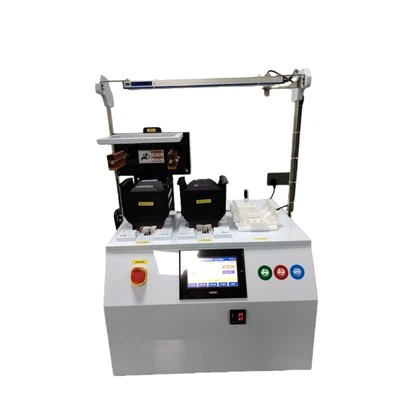
Semiconductor microscopes are essential tools in the semiconductor industry, enabling researchers and engineers to visualize and analyze semiconductor materials and devices at the micro and nanoscale. Understanding the power consumption characteristics of these microscopes is crucial for optimizing their performance, reducing operational costs, and ensuring energy efficiency. As a leading semiconductor microscope supplier, we have in - depth knowledge of these characteristics, which we will share in this blog.
1. General Power Consumption Components
Semiconductor microscopes consist of several key components, each with its own power consumption requirements. The main components include the light source, the imaging system, the stage control system, and the data acquisition and processing unit.
Light Source
The light source is one of the most power - hungry components in a semiconductor microscope. Different types of light sources are used, such as halogen lamps, LED lights, and lasers. Halogen lamps are known for their high brightness but also consume a significant amount of power. They typically operate at power levels ranging from 30 to 100 watts. LED lights, on the other hand, are more energy - efficient. They can provide comparable brightness with much lower power consumption, usually in the range of 5 to 20 watts. Lasers, which are often used in advanced semiconductor microscopes for high - resolution imaging and spectroscopy, can have a wide range of power consumption depending on their type and application. Some low - power lasers may consume only a few milliwatts, while high - power lasers used for certain types of microscopy can consume several watts.
Imaging System
The imaging system includes the objective lenses, cameras, and associated electronics. The power consumption of the objective lenses is relatively low, mainly used for focusing and magnification. However, high - end cameras with high - resolution sensors and fast frame rates can consume a significant amount of power. For example, a high - resolution CCD or CMOS camera used in semiconductor microscopy may consume 10 to 50 watts, depending on its specifications.
Stage Control System
The stage control system is responsible for moving the sample in the x, y, and z directions. This system typically consists of motors and drivers. The power consumption of the stage control system depends on the size and weight of the stage, as well as the required speed and precision of movement. Smaller stages with lower - power motors may consume 5 to 10 watts, while larger and more precise stages can consume up to 50 watts or more.
Data Acquisition and Processing Unit
The data acquisition and processing unit is used to capture, store, and analyze the images and data obtained from the microscope. This unit usually includes a computer or a dedicated data acquisition card. The power consumption of this unit can vary widely depending on the processing power and memory requirements. A standard desktop computer used for data processing may consume 100 to 300 watts, while a more powerful workstation can consume even more.
2. Power Consumption in Different Operating Modes
Semiconductor microscopes can operate in different modes, such as continuous operation, intermittent operation, and standby mode. Each mode has different power consumption characteristics.
Continuous Operation
In continuous operation, all components of the microscope are running at full capacity. This mode is typically used when performing long - term imaging or analysis tasks. The power consumption in continuous operation is the sum of the power consumption of all components. For example, if a microscope has a 50 - watt light source, a 30 - watt camera, a 20 - watt stage control system, and a 200 - watt data acquisition and processing unit, the total power consumption in continuous operation would be 300 watts.
Intermittent Operation
Intermittent operation involves turning on and off certain components as needed. For example, the light source and the camera may be turned off when not in use, while the stage control system and the data acquisition unit remain in a low - power standby state. This can significantly reduce power consumption. In intermittent operation, the average power consumption can be much lower than in continuous operation, depending on the duty cycle of the components.
Standby Mode
In standby mode, most of the components are in a low - power state, consuming only a small amount of power to maintain basic functionality. For example, the light source may be turned off, the camera may be in a sleep mode, and the stage control system may be set to a low - power standby state. The power consumption in standby mode is typically less than 10% of the power consumption in continuous operation.
3. Impact of Advanced Features on Power Consumption
Advanced features in semiconductor microscopes, such as 3D imaging, photoelectrical analysis, and magneto - optic Kerr effect microscopy, can have a significant impact on power consumption.
3D Optical Profiler
A 3D Optical Profiler is used to obtain three - dimensional topographical information of semiconductor samples. This feature often requires a high - power light source and a high - resolution camera to capture detailed 3D images. As a result, the power consumption of a microscope equipped with a 3D optical profiler is usually higher than that of a standard microscope. The additional power is mainly used for the light source and the data processing required to reconstruct the 3D images.
Microscope - Based Photoelectrical Analysis System
A Microscope - Based Photoelectrical Analysis System is used to study the photoelectrical properties of semiconductor materials. This system typically includes a light source for illumination, a detector for measuring photocurrents, and a data acquisition unit for analyzing the data. The power consumption of this system is influenced by the power of the light source, the sensitivity of the detector, and the processing power required for data analysis.
Magneto - Optic Kerr Effect Microscopy System
A Magneto - Optic Kerr Effect Microscopy System is used to study the magnetic properties of semiconductor materials. This system requires a magnetic field generator, a light source, and a detector. The power consumption of this system is mainly determined by the power of the magnetic field generator and the light source. High - strength magnetic fields require more power, and the light source needs to be bright enough to detect the small changes in the polarization of light due to the magneto - optic Kerr effect.
4. Strategies for Reducing Power Consumption
As a semiconductor microscope supplier, we understand the importance of reducing power consumption for our customers. Here are some strategies that can be implemented to achieve this goal:
Energy - Efficient Components
We recommend using energy - efficient components, such as LED light sources and low - power cameras. These components can significantly reduce power consumption without sacrificing performance.


Intelligent Power Management
Implementing intelligent power management systems can help optimize power consumption. For example, the microscope can be programmed to automatically turn off certain components when not in use or to adjust the power output of the light source based on the imaging requirements.
Regular Maintenance
Regular maintenance of the microscope can ensure that all components are operating at their optimal efficiency. This includes cleaning the lenses, checking the electrical connections, and replacing any worn - out components.
5. Conclusion and Call to Action
In conclusion, understanding the power consumption characteristics of semiconductor microscopes is essential for optimizing their performance and reducing operational costs. As a leading semiconductor microscope supplier, we are committed to providing our customers with high - quality microscopes that are energy - efficient and reliable. If you are interested in learning more about our semiconductor microscopes or have any questions about power consumption, please contact us for a detailed consultation. We look forward to discussing your specific needs and helping you find the best solution for your semiconductor research and development requirements.
References
- Smith, J. (2018). Semiconductor Microscopy: Principles and Applications. New York: Wiley.
- Brown, A. (2020). Energy - Efficient Design of Microscopy Systems. Journal of Microscopy and Microanalysis, 26(3), 456 - 465.
- Green, C. (2019). Advanced Features in Semiconductor Microscopes and Their Impact on Power Consumption. Proceedings of the International Conference on Semiconductor Technology, 234 - 241.