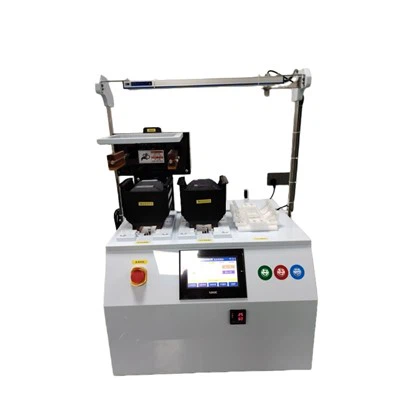
Magnetic properties play a crucial role in numerous industrial and scientific applications, from electronics and telecommunications to aerospace and automotive industries. Environmental test chambers are essential tools for evaluating the magnetic properties of materials under various simulated conditions. In this blog, we will explore the test methods for magnetic property testing in environmental test chambers, as an environmental test chamber supplier, shedding light on the importance and procedures of these tests.
Importance of Magnetic Property Testing in Environmental Test Chambers
Environmental factors such as temperature, humidity, and pressure can significantly affect the magnetic properties of materials. For instance, extreme temperatures can cause changes in the magnetization of ferromagnetic materials, leading to performance degradation or failure in magnetic devices. By conducting magnetic property tests in environmental test chambers, manufacturers can ensure the reliability and stability of their magnetic products under different real - world conditions.
Types of Environmental Test Chambers
As an environmental test chamber supplier, we offer a wide range of test chambers suitable for magnetic property testing. Some of our popular products include:


- Rapid Temperature Change Test Chamber: This chamber can rapidly change the temperature, allowing for testing of magnetic materials' performance under dynamic temperature conditions.
- Walk - in Temperature and Humidity Chamber: Ideal for large - scale magnetic components, it can simulate different temperature and humidity combinations to assess the long - term stability of magnetic properties.
- Thermal Impact Chamber: This chamber subjects the test samples to sudden and extreme temperature changes, which is useful for evaluating the resistance of magnetic materials to thermal shock.
- Anaerobic Oven: It provides an oxygen - free environment, which can be crucial when testing magnetic materials that are sensitive to oxidation.
- Aging Chamber: This chamber can accelerate the aging process of magnetic materials, helping to predict their long - term performance.
Test Methods for Magnetic Property Testing in Environmental Test Chambers
1. Magnetization Curve Measurement
- Principle: The magnetization curve, also known as the B - H curve, describes the relationship between the magnetic flux density (B) and the magnetic field strength (H) of a magnetic material. By measuring the magnetization curve under different environmental conditions in the test chamber, we can understand how the material's magnetic properties change with temperature, humidity, etc.
- Procedure: First, a test sample is placed in the environmental test chamber. A magnetic field is then applied to the sample using a solenoid or an electromagnet. The magnetic field strength (H) can be adjusted by changing the current in the solenoid. The magnetic flux density (B) of the sample is measured using a Hall sensor or a search coil. As the magnetic field strength is gradually increased from zero, the corresponding magnetic flux density values are recorded, and the magnetization curve can be plotted.
2. Residual Magnetism Measurement
- Principle: Residual magnetism, or remanence, is the magnetic flux density that remains in a magnetic material after the removal of an external magnetic field. Measuring the residual magnetism under different environmental conditions helps determine the stability of the magnetic material.
- Procedure: The test sample is first magnetized to saturation in the environmental test chamber using a strong external magnetic field. The external magnetic field is then removed, and the remaining magnetic flux density (residual magnetism) is measured using a suitable magnetic sensor. This process can be repeated at different temperatures, humidity levels, etc., to observe the changes in residual magnetism.
3. Coercivity Measurement
- Principle: Coercivity is the magnetic field strength required to reduce the magnetic flux density of a magnetized material to zero. It is an important parameter that reflects the resistance of the material to demagnetization.
- Procedure: After magnetizing the test sample to saturation in the environmental test chamber, an opposite - direction magnetic field is gradually increased until the magnetic flux density of the sample becomes zero. The value of the magnetic field strength at this point is the coercivity. This measurement can be carried out at different environmental conditions to study the impact of temperature, humidity, etc., on coercivity.
4. Permeability Measurement
- Principle: Permeability is a measure of how easily a magnetic field can penetrate a material. It is defined as the ratio of the magnetic flux density (B) to the magnetic field strength (H). Measuring permeability under different environmental conditions is essential for understanding the magnetic behavior of materials.
- Procedure: A small-amplitude alternating magnetic field is applied to the test sample in the environmental test chamber. The magnetic flux density and the magnetic field strength are measured simultaneously. The permeability can be calculated as the ratio of the root - mean - square values of B and H. By changing the environmental conditions and repeating the measurement, the variation of permeability with temperature, humidity, etc., can be determined.
Challenges and Solutions in Magnetic Property Testing in Environmental Test Chambers
- Temperature-Induced Noise: High temperatures can cause thermal noise in magnetic sensors, affecting the accuracy of magnetic property measurements. To solve this problem, we can use high - quality sensors with low thermal noise or employ temperature - compensation techniques.
- Humidity - Induced Corrosion: In a high - humidity environment, magnetic materials may suffer from corrosion, which can alter their magnetic properties. To prevent this, we can coat the test samples with corrosion - resistant materials or use a protective gas in the environmental test chamber.
Conclusion
Magnetic property testing in environmental test chambers is of great significance for ensuring the quality and reliability of magnetic materials and products. As an environmental test chamber supplier, we provide a variety of test chambers that can simulate different environmental conditions for comprehensive magnetic property testing. By using the appropriate test methods and addressing the associated challenges, manufacturers can obtain accurate and reliable magnetic property data, which is essential for product development and quality control.
If you are interested in our environmental test chambers for magnetic property testing or have any procurement - related questions, please feel free to contact us for a detailed discussion. Our professional team is ready to provide you with the most suitable solutions.
References
- Cullity, B. D., & Graham, C. D. (2008). Introduction to Magnetic Materials. Wiley-IEEE Press.
- O'Handley, R. C. (2000). Modern Magnetic Materials: Principles and Applications. Wiley.