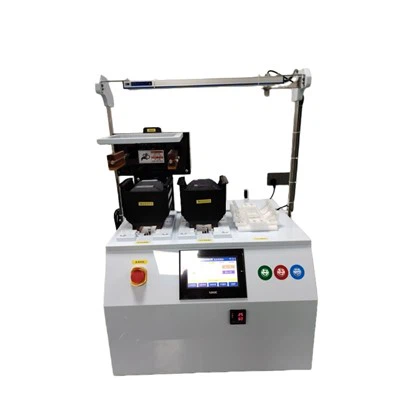
Hey there! I'm a supplier of lithography machines, and today, I wanna chat about the challenges we face when using these machines for printed circuit board (PCB) production. It ain't all sunshine and rainbows, that's for sure.
First off, let's talk about precision. PCBs are getting smaller and more complex with each passing day. The components are packed closer together, and the traces are thinner. This means that lithography machines need to be super precise. Even the tiniest error can lead to a faulty PCB, which is a huge headache for manufacturers. One of the main issues here is alignment. The machine has to align the pattern on the mask (or in the case of Maskless Lithography Machine, the digital pattern) perfectly with the PCB substrate. Any misalignment, even by a few micrometers, can cause short - circuits or open - circuits. It's like trying to hit a bullseye from a mile away!
Another challenge is resolution. High - end PCBs require high - resolution patterns. The lithography machine needs to be able to create fine lines and small features accurately. For example, in some advanced PCBs, we're talking about lines that are just a few micrometers wide. Achieving this level of resolution is no easy feat. It depends on the quality of the optical system in the lithography machine, as well as the type of resist used on the PCB. If the machine doesn't have a good enough optical system, the edges of the patterns may be fuzzy, and the overall quality of the PCB will suffer.
Cost is also a major factor. Lithography machines are not cheap. They require a significant investment, both in terms of the initial purchase price and the ongoing maintenance costs. For small and medium - sized PCB manufacturers, this can be a real deterrent. The high cost also means that manufacturers need to make sure they're using the machine efficiently. If the machine is down for maintenance too often or if it's not being used to its full capacity, it can eat into the profits. And let's not forget about the cost of the consumables, like the photoresist and the masks. These can add up over time and put a strain on the budget.
Now, let's discuss the speed of production. In today's fast - paced market, manufacturers need to produce PCBs quickly to meet the demand. However, lithography is a relatively slow process. It involves multiple steps, such as applying the photoresist, exposing it to light, developing it, and then etching the pattern. Each of these steps takes time, and any delay can slow down the entire production line. Plus, if the machine has to make multiple exposures to achieve the desired pattern, it can take even longer. So, finding ways to speed up the lithography process without sacrificing quality is a constant challenge.
The environmental conditions also play a crucial role. Lithography is a very sensitive process, and it's highly affected by factors like temperature, humidity, and dust. Even a small change in temperature can cause the PCB substrate to expand or contract slightly, which can affect the alignment and the accuracy of the pattern. Dust particles in the air can land on the photoresist or the mask and cause defects in the pattern. So, manufacturers need to maintain a clean and controlled environment for the lithography process. This means investing in things like clean rooms and air - filtration systems, which adds to the cost.
When it comes to different types of lithography machines, each has its own set of challenges. For instance, E - Beam Lithography System offers extremely high resolution, but it's very slow. The electron beam has to scan the pattern point by point, which takes a long time, especially for large - area PCBs. On the other hand, mask - based lithography machines require the creation of expensive masks. If there's a mistake in the mask design, it has to be redone, which is time - consuming and costly.
Then, there's the issue of software and compatibility. Modern lithography machines are highly automated and rely on sophisticated software to control the process. However, integrating this software with the existing manufacturing systems can be a challenge. Sometimes, the software may not be compatible with the operating systems or other software used in the factory. This can lead to errors and downtime, as technicians have to spend time troubleshooting the compatibility issues.
Let's also touch on the skills required to operate these machines. Lithography machines are complex pieces of equipment, and they require skilled operators. Operators need to have a good understanding of the principles of lithography, as well as the ability to operate and maintain the machine. Finding and training qualified operators can be difficult, especially in regions where there's a shortage of skilled labor. And even once an operator is trained, they need to keep up with the latest technologies and techniques to ensure optimal performance of the machine.
Another challenge related to technology advancements. The field of PCB production is constantly evolving, and new requirements are emerging all the time. Lithography machines need to keep up with these changes. For example, with the growing demand for flexible PCBs, the lithography process needs to be adapted to work with flexible substrates. These substrates have different properties compared to traditional rigid substrates, such as different thermal expansion coefficients and flexibility. This requires new techniques and modifications to the existing lithography machines.
In addition, the industry is moving towards more sustainable manufacturing practices. Lithography machines use various chemicals, such as photoresists and etchants, which can be harmful to the environment. Manufacturers are under increasing pressure to reduce their environmental impact. This means finding more eco - friendly alternatives to these chemicals and developing more energy - efficient lithography machines. However, making these changes while maintaining the quality and performance of the PCBs is a challenging task.
Despite all these challenges, lithography machines are still an essential part of PCB production. They offer the precision and accuracy needed to create high - quality PCBs. At our company, we're constantly working on improving our lithography machines to overcome these challenges. We're developing new technologies to increase precision, resolution, and speed, while also reducing costs and environmental impact.
If you're in the PCB production business and are looking for a reliable lithography machine, we'd love to talk to you. Whether you need a Maskless Lithography Machine, an E - Beam Lithography System, a 6‑inch Spin‑coater And Developer, a Nano 3D Lithography System, or a 12‑inch Spin‑coater And Developer, we've got you covered. Don't hesitate to get in touch to discuss your specific needs and see how our machines can improve your production process.


References
- Jain, A., & Singh, R. (2019). Advanced Lithography Techniques for PCB Manufacturing. Journal of Printed Circuit Technology.
- Smith, J. (2020). Challenges and Solutions in High - Resolution PCB Lithography. International Journal of Electronics and Electrical Engineering.
- Brown, L. (2021). Environmental Considerations in PCB Lithography. Sustainable Manufacturing Journal.