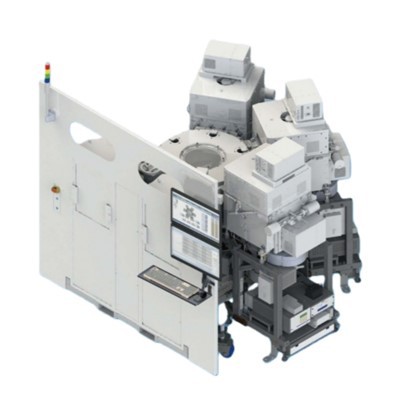

Product overview
The Vertical LPCVD TEOS/Poly/SiN is a low-pressure chemical vapor deposition system for semiconductor manufacturing. It's used to deposit high quality Poly, TEOS, SiN, and HTO thin films. With a vertical chamber design, it delivers stable thermal and process control, and works well in IC, power device, and MEMS production.
Advantages
It's stable and reliable: solid mechanical design and tight process control help keep film uniformity and repeatability consistent.
Safety is built in: over temperature / over pressure protection, leak detection, and emergency stop reduce risks for operators and equipment.
Operation and maintenance are straightforward: the interface is easy to use, and the modular layout cuts down on downtime.
It supports high throughput and flexibility: compatible with 6/8/12 inch wafers (up to 150 per batch) and processes from 400°C to 1250°C.
Applications
1. IC manufacturing: gate dielectrics, spacers, passivation, and interlayer films for logic, memory, and analog chips.
2. Power devices: Poly, SiN, and TEOS films for MOSFETs, IGBTs, and other high voltage / high reliability components.
3. MEMS: structural, sacrificial, and packaging films for sensors and actuators.
4. Advanced packaging: dielectric and passivation layers in wafer level and 3D packaging.
FAQ
Q: What is a Vertical LPCVD System used for?
A: A Vertical LPCVD System is a type of low-pressure chemical vapor deposition equipment mainly used in semiconductor production. It's designed to deposit high-quality thin films such as Poly, TEOS, SiN, and HTO onto wafers for chip and device manufacturing.
Q: What advantages does the Vertical LPCVD System offer?
A: One big benefit is stable and uniform film deposition, which is critical for semiconductor processes. It also runs reliably over long production periods, includes multiple safety protections, and is relatively easy to operate and maintain. The vertical design also supports higher throughput and better space efficiency in cleanrooms.
Q: What wafer sizes are compatible with this system?
A: Most models support 6-inch, 8-inch, and 12-inch wafers, making it suitable for many different production lines, from R&D trials to mass manufacturing.
Q: What thin films can a Vertical LPCVD System deposit?
A: Common ones include polycrystalline silicon (Poly), TEOS oxide, silicon nitride (SiN), and high-temperature oxide (HTO). These films are widely used in IC, power device, and MEMS fabrication.
Q: What temperature range does the system work in?
A: Typical process temperatures range from around 400°C up to 1250°C, covering most standard deposition requirements for oxide, nitride, and poly films.
Q: Where are Vertical LPCVD Systems commonly applied?
A: They're widely used in integrated circuit manufacturing, power semiconductors, MEMS devices, and advanced wafer-level packaging processes.
Q: Does the Vertical LPCVD System include safety features?
A: Yes, standard systems come with multiple safety functions, such as over-temperature protection, over-pressure protection, gas leak detection, and emergency stop, to ensure stable and secure daily operation.
Q: Why choose a vertical LPCVD over a horizontal one?
A: Vertical systems generally provide better thermal uniformity, higher batch capacity, smaller footprint, and easier maintenance. These make them more popular in modern semiconductor fabs.
Hot Tags: vertical lpcvd system, China vertical lpcvd system manufacturers, suppliers, LPCVD System, LPCVD Furnace, thin film deposition equipment, 3D Surface Topography Measurement System, 3D Optical Surface Measurement System, Low Pressure Chemical Vapor Deposition Equipment