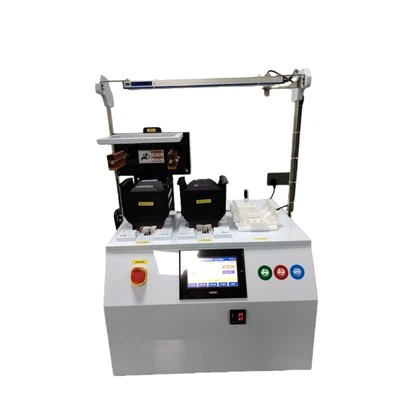
Hey there! As a supplier of ICP Etchers, I've seen firsthand how crucial the gas flow pattern is in the etching process. In this blog, I'm gonna break down how the gas flow pattern affects etching in an ICP Etcher.
Understanding the Basics of ICP Etching
Before we dive into the gas flow pattern, let's quickly go over what ICP etching is. Inductively Coupled Plasma (ICP) etching is a popular technique used in semiconductor manufacturing and microfabrication. It uses a high - density plasma to etch materials with high precision and selectivity. The ICP source generates a plasma by inductively coupling radio - frequency (RF) power into a gas mixture, creating ions and radicals that react with the material being etched.
The Role of Gas Flow Pattern
The gas flow pattern in an ICP Etcher is like the traffic flow in a busy city. It determines how the reactive species (ions and radicals) are distributed within the etching chamber, and this distribution has a huge impact on the etching process.
Uniformity of Etching
One of the most important aspects of etching is achieving uniform etching across the substrate. A well - designed gas flow pattern can help ensure that the reactive species are evenly distributed over the surface of the substrate. If the gas flow is uneven, some areas of the substrate may receive more reactive species than others, leading to non - uniform etching. For example, if the gas is flowing too fast on one side of the chamber, the etching rate on that side will be higher, resulting in a non - flat surface. This can be a major problem, especially in applications where high precision is required, like in the production of microchips.
Our ICP Deep Si Etcher is designed with a carefully engineered gas flow system to ensure excellent etching uniformity. The gas inlet and outlet are strategically placed to create a balanced flow of reactive gases across the substrate, minimizing the variation in etching rate.
Etching Rate
The gas flow pattern also affects the etching rate. A higher flow rate of reactive gases can increase the concentration of reactive species in the plasma, which generally leads to a higher etching rate. However, if the flow rate is too high, the residence time of the reactive species in the chamber may be too short, and they may not have enough time to react with the substrate effectively. On the other hand, a very low flow rate can result in a low concentration of reactive species, leading to a slow etching rate.
We've optimized the gas flow in our Cu And Ti Etcher to achieve an ideal balance between flow rate and etching rate. By adjusting the gas flow parameters, we can control the etching rate to meet the specific requirements of different applications.
Selectivity
Selectivity is another key factor in etching. It refers to the ability to etch one material preferentially over another. The gas flow pattern can influence selectivity by affecting the distribution of different reactive species. For example, in a multi - gas etching process, different gases may be used to etch different materials. A proper gas flow pattern can ensure that the right reactive species reach the right areas of the substrate, improving the selectivity of the etching process.
In our 6" CCP Etcher, we use advanced gas flow control techniques to enhance selectivity. The gas flow can be adjusted to ensure that the reactive species for the target material are concentrated in the desired areas, while minimizing the interaction with other materials on the substrate.


Factors Affecting Gas Flow Pattern
There are several factors that can affect the gas flow pattern in an ICP Etcher.
Chamber Design
The shape and size of the etching chamber play a significant role in determining the gas flow pattern. A well - designed chamber can promote a laminar flow of gases, which is more stable and predictable compared to a turbulent flow. The placement of gas inlets, outlets, and other components within the chamber also affects the flow. For example, if the gas inlet is too close to the substrate, it may cause a non - uniform distribution of reactive species.
Gas Properties
The properties of the gases used in the etching process, such as their viscosity and density, can also influence the gas flow pattern. Different gases may flow differently under the same conditions, and this needs to be taken into account when designing the gas flow system. For example, a gas with a high viscosity may flow more slowly than a gas with a low viscosity.
Pressure
The pressure inside the etching chamber affects the gas flow pattern. At low pressures, the gas molecules have a longer mean free path, which can lead to a more diffuse flow. At high pressures, the gas flow may be more restricted, and the distribution of reactive species may be different. We carefully control the pressure in our etchers to optimize the gas flow pattern for different etching processes.
Optimizing Gas Flow Pattern
To optimize the gas flow pattern in an ICP Etcher, we use a combination of experimental and simulation techniques. We conduct experiments to measure the etching results under different gas flow conditions and use computational fluid dynamics (CFD) simulations to model the gas flow inside the chamber. By analyzing the experimental data and simulation results, we can fine - tune the gas flow parameters, such as the flow rate, inlet position, and pressure, to achieve the best etching performance.
Conclusion
In conclusion, the gas flow pattern is a critical factor in the etching process of an ICP Etcher. It affects the uniformity, rate, and selectivity of etching, and there are many factors that can influence it. As a supplier of ICP Etchers, we're constantly working on improving the gas flow design in our products to provide our customers with the best etching performance.
If you're in the market for an ICP Etcher or have any questions about how gas flow pattern affects etching, don't hesitate to reach out. We'd be more than happy to have a chat and discuss how our etchers can meet your specific needs. Whether it's for semiconductor manufacturing, microfabrication, or any other application, we've got the expertise and the right etcher for you. Contact us today to start a procurement discussion and take your etching process to the next level.
References
- "Plasma Etching: An Introduction" by J. L. Vossen and W. Kern.
- "Semiconductor Manufacturing Technology" by S. Wolf.
- Research papers on ICP etching and gas flow optimization from leading academic journals.