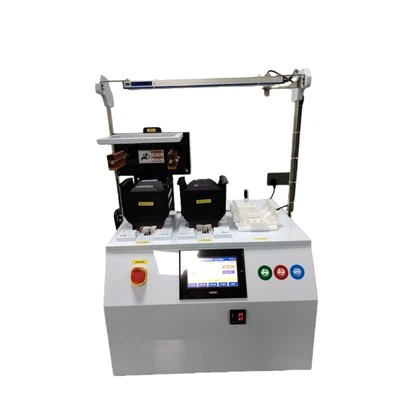
Hey there! As a supplier of ICP Etchers, I've seen firsthand how crucial the gas mixture ratio is in the etching process. So, let's dive into how the gas mixture ratio affects etching in an ICP Etcher.


First off, what's an ICP Etcher? Well, it stands for Inductively Coupled Plasma Etcher. You can check out more about it on our ICP Etcher page. These machines use plasma to etch materials, and the gas mixture ratio plays a huge role in determining the quality and efficiency of the etching.
The Basics of Gas Mixtures in ICP Etching
In an ICP Etcher, different gases are used for different purposes. For example, some gases are used to create the plasma, while others are used to react with the material being etched. The most common gases used in ICP etching include argon (Ar), oxygen (O₂), and fluorine - containing gases like SF₆ and CF₄.
The ratio of these gases in the mixture can have a significant impact on the etching process. Let's take a look at some of the key ways the gas mixture ratio affects etching.
Etching Rate
The etching rate is one of the most important parameters in the etching process. It refers to how fast the material is being removed. The gas mixture ratio can greatly influence the etching rate. For instance, increasing the concentration of a reactive gas like SF₆ in the mixture can generally increase the etching rate. This is because SF₆ can react with many materials, such as silicon, to form volatile compounds that are easily removed from the surface.
However, it's not always a straightforward relationship. Sometimes, if the ratio of reactive gases is too high, it can lead to a decrease in the etching rate. This is because an excessive amount of reactive species can cause the formation of a polymer layer on the surface, which can slow down the etching process.
Selectivity
Selectivity is another crucial factor. It refers to the ability of the etching process to etch one material over another. For example, in semiconductor manufacturing, we often want to etch a specific layer without damaging the underlying layers. The gas mixture ratio can be adjusted to achieve high selectivity.
Let's say we want to etch a silicon layer on top of a silicon dioxide layer. By adjusting the ratio of gases like CF₄ and O₂, we can increase the selectivity of the etching process towards silicon. The CF₄ can react with silicon to form volatile compounds, while the O₂ can help to remove any polymer residues that might form during the etching.
Profile Control
The gas mixture ratio also affects the profile of the etched features. We want to achieve a well - defined and vertical profile in many applications. For example, in the fabrication of microelectromechanical systems (MEMS), vertical sidewalls are often required.
The addition of a small amount of argon to the gas mixture can help with profile control. Argon ions can bombard the surface and help to remove any sidewall deposits, resulting in a more vertical profile. On the other hand, if the ratio of reactive gases is not properly controlled, it can lead to undercutting or over - etching, which can ruin the desired profile.
Real - World Examples
Let's look at some real - world scenarios where the gas mixture ratio makes a big difference.
Metal Etching
In Metal Etching System, the gas mixture ratio is carefully tuned to achieve the best results. For example, when etching aluminum, a mixture of chlorine - containing gases like BCl₃ and Cl₂ is often used. The ratio of these gases can affect the etching rate, selectivity, and profile of the aluminum features. If the ratio of BCl₃ is too high, it can lead to rough surfaces and poor selectivity.
Hard Mask Etching
In Hard Mask Etching System, the gas mixture ratio is also critical. Hard masks are used to protect certain areas of the substrate during the etching process. The gas mixture needs to be adjusted to etch the hard mask material while minimizing damage to the underlying layers. For example, when using a silicon nitride hard mask, a mixture of fluorine - containing gases and oxygen can be used. The ratio of these gases can determine the etch rate and selectivity of the hard mask etching.
How to Optimize the Gas Mixture Ratio
Optimizing the gas mixture ratio is not an easy task. It requires a lot of experimentation and understanding of the etching process. Here are some general tips:
- Start with the manufacturer's recommendations: Most ICP Etchers come with some recommended gas mixture ratios for common applications. These can be a good starting point for your experiments.
- Conduct small - scale experiments: Make small changes to the gas mixture ratio and observe the changes in the etching results. This can help you to understand the relationship between the ratio and the etching parameters.
- Use in - situ monitoring: Many modern ICP Etchers are equipped with in - situ monitoring tools that can provide real - time information about the etching process. This can help you to adjust the gas mixture ratio more accurately.
Conclusion
In conclusion, the gas mixture ratio has a profound impact on the etching process in an ICP Etcher. It affects the etching rate, selectivity, and profile of the etched features. As a supplier of ICP Etchers, we understand the importance of getting the gas mixture ratio right. We offer high - quality ICP Etchers and provide support to help our customers optimize their etching processes.
If you're interested in learning more about our ICP Etchers or have any questions about the gas mixture ratio and etching, don't hesitate to contact us for a procurement discussion. We're here to help you achieve the best results in your etching applications.
References
- Smith, J. (2018). Plasma Etching in Semiconductor Manufacturing. Springer.
- Jones, A. (2020). Gas Mixtures for Plasma Etching: A Review. Journal of Vacuum Science and Technology.