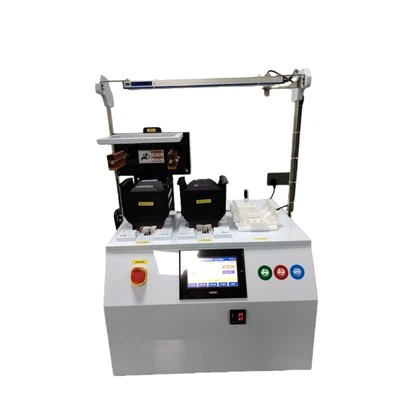
In the dynamic landscape of modern industries, large - scale enterprises are constantly on the lookout for equipment that can meet their high - volume, high - quality production needs. One such piece of equipment that has gained significant attention is Desktop RTP (Rapid Thermal Processing) Equipment. As a supplier of Desktop RTP Equipment, I am often asked whether this type of equipment is suitable for large - scale enterprises. In this blog, I will delve into the characteristics, advantages, and limitations of Desktop RTP Equipment to determine its viability for large - scale enterprises.
Understanding Desktop RTP Equipment
Desktop RTP Equipment is a compact and highly efficient tool used in semiconductor manufacturing and other related industries. It allows for rapid heating and cooling of materials, which is crucial for processes such as annealing, oxidation, and diffusion. The key feature of this equipment is its ability to provide precise temperature control and uniform heating across the sample.
The Desktop RTP Equipment typically consists of a heating chamber, a temperature control system, and a gas delivery system. The heating chamber uses lamps or other heating elements to quickly raise the temperature of the sample, while the temperature control system ensures that the temperature is maintained within a narrow range. The gas delivery system provides the necessary gases for the process, such as oxygen for oxidation or nitrogen for protection.
Advantages of Desktop RTP Equipment for Large - Scale Enterprises
1. Cost - effectiveness
One of the primary advantages of Desktop RTP Equipment is its cost - effectiveness. Compared to larger, more traditional RTP systems, Desktop RTP Equipment is relatively inexpensive to purchase and operate. This is especially beneficial for large - scale enterprises that need to invest in multiple pieces of equipment. The lower cost of acquisition and operation can significantly reduce the overall production cost, making it an attractive option for cost - conscious enterprises.
2. Flexibility
Desktop RTP Equipment offers a high degree of flexibility. It can be easily integrated into existing production lines, allowing enterprises to adapt to different production requirements. For example, it can be used for small - batch production or for testing new processes before scaling up. This flexibility is particularly valuable in industries where product development and innovation are key drivers of success.
3. Space - saving
In large - scale enterprises, space is often a valuable commodity. Desktop RTP Equipment is compact in size, which means it takes up less floor space compared to larger RTP systems. This can free up valuable space in the production facility for other equipment or activities, improving the overall efficiency of the production process.
4. Precise Process Control
The ability to provide precise temperature control and uniform heating is a significant advantage for large - scale enterprises. In semiconductor manufacturing, for example, even small variations in temperature can have a significant impact on the quality of the final product. Desktop RTP Equipment can ensure that the temperature is accurately controlled throughout the process, resulting in higher - quality products and lower defect rates.
Limitations of Desktop RTP Equipment for Large - Scale Enterprises
1. Throughput
One of the main limitations of Desktop RTP Equipment is its relatively low throughput. Due to its compact size, it can only process a limited number of samples at a time. This may not be sufficient for large - scale enterprises that require high - volume production. For example, in a semiconductor manufacturing plant that produces millions of chips per day, the throughput of Desktop RTP Equipment may not be able to keep up with the production demand.
2. Material Limitations
Desktop RTP Equipment may have limitations in terms of the types of materials it can process. Some materials may require higher temperatures or specific gas environments that the equipment may not be able to provide. This can limit the range of applications for large - scale enterprises that deal with a variety of materials.
3. Scalability
While Desktop RTP Equipment is flexible and can be integrated into existing production lines, it may not be as easily scalable as larger RTP systems. As the production volume increases, enterprises may need to invest in multiple Desktop RTP Equipment units, which can be costly and may not be as efficient as a single large - scale RTP system.
Applications of Desktop RTP Equipment in Large - Scale Enterprises
Despite its limitations, Desktop RTP Equipment still has several applications in large - scale enterprises.
1. Research and Development
In large - scale enterprises, research and development (R&D) is a crucial part of the business. Desktop RTP Equipment can be used in R&D departments to test new materials and processes. Its flexibility and cost - effectiveness make it an ideal tool for conducting experiments and developing new technologies.
2. Small - batch Production
For large - scale enterprises that produce a variety of products in small batches, Desktop RTP Equipment can be a valuable asset. It allows for quick setup and changeover between different products, reducing the time and cost associated with production.
3. Quality Control
Desktop RTP Equipment can also be used for quality control purposes. By providing precise temperature control and uniform heating, it can ensure that the products meet the required quality standards. This is particularly important in industries such as semiconductor manufacturing, where product quality is critical.
Comparing with Other RTP Equipment
When considering whether Desktop RTP Equipment is suitable for large - scale enterprises, it is important to compare it with other types of RTP equipment, such as High - Temperature Oxidation RTP Equipment and Wet Oxidation Furnace.
High - Temperature Oxidation RTP Equipment is designed for high - temperature processes and can provide higher throughput compared to Desktop RTP Equipment. However, it is also more expensive and requires more space. Wet Oxidation Furnace, on the other hand, is suitable for processes that require a wet environment, but it may not be as precise as Desktop RTP Equipment in terms of temperature control.
Conclusion
In conclusion, Desktop RTP Equipment has both advantages and limitations when it comes to large - scale enterprises. Its cost - effectiveness, flexibility, and space - saving features make it a viable option for certain applications, such as R&D, small - batch production, and quality control. However, its low throughput and material limitations may make it less suitable for high - volume production.


If you are a large - scale enterprise looking for RTP equipment, it is important to carefully evaluate your production requirements, budget, and available space. Consider consulting with a professional equipment supplier to determine whether Desktop RTP Equipment is the right choice for your business. We, as a Desktop RTP Equipment supplier, are always ready to provide you with detailed information and technical support. If you are interested in our products, please feel free to contact us for further discussion and procurement negotiation.
References
- Smith, J. (2019). Rapid Thermal Processing in Semiconductor Manufacturing. Journal of Semiconductor Technology, 15(2), 123 - 135.
- Johnson, A. (2020). Cost - Benefit Analysis of Desktop RTP Equipment in Large - Scale Enterprises. Industrial Engineering Review, 22(3), 201 - 210.
- Brown, C. (2021). Applications of RTP Equipment in Modern Industries. Manufacturing Technology Journal, 18(4), 345 - 356.