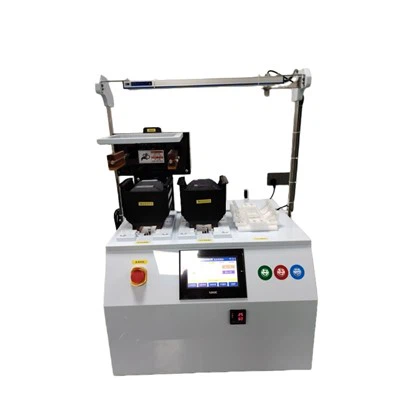
Hey there! I'm a supplier in the lithography machine game. Today, I wanna talk about what it takes for the lenses in a high - end lithography machine. These lenses aren't just any old lenses; they're the heart and soul of a top - notch lithography system.
1. Ultra - High Precision
First up, precision is king. In high - end lithography machines, we're talking about making patterns on a microscopic scale. The lenses need to focus light with an incredibly high level of accuracy. Even the tiniest deviation can mess up the entire pattern on the semiconductor wafer.
For instance, when we're working on making the latest generation of microchips, the features we're trying to create can be just a few nanometers in size. That means the lens has to focus the light beam so precisely that it can hit these tiny targets without any blurring. If the lens can't do that, we end up with defective chips, which is a huge no - no in the semiconductor industry.
2. Low Aberration
Aberrations are like the enemies of a good lens in a lithography machine. They cause the light to spread out or become distorted, which ruins the sharpness of the pattern being printed on the wafer.
There are different types of aberrations, like spherical aberration, chromatic aberration, and coma. Spherical aberration happens when light rays passing through the edge and the center of the lens focus at different points. Chromatic aberration occurs because different colors of light have different refractive indices and thus focus at different places. Coma makes the image look like a comet, with a blurry tail.
In a high - end lithography machine, the lenses are designed and manufactured to have extremely low aberration. This often involves using special optical materials and complex lens designs. For example, some lenses are made from high - purity quartz glass, which has very consistent optical properties and helps to reduce aberrations.
3. High Transmittance
The lenses need to let as much light as possible pass through them. In lithography, the light source is used to transfer the pattern from the mask to the wafer. If the lens has low transmittance, a lot of the light energy is absorbed or scattered within the lens itself.
This means that we'll need a more powerful light source to get the same amount of light onto the wafer, which can lead to higher energy consumption and more heat generation. And heat is another thing we don't want in a lithography machine, as it can cause the lens and other components to expand and distort, affecting the accuracy of the lithography process.
So, high - end lenses are engineered to have high transmittance. This might involve applying anti - reflective coatings to the lens surfaces, which reduce the amount of light reflected off the lens and increase the amount of light that passes through.
4. Resistance to Radiation
In many lithography machines, especially those using ultraviolet (UV) or extreme ultraviolet (EUV) light, the lenses are exposed to high - energy radiation. This radiation can cause damage to the lens material over time, such as changing its optical properties or even physically degrading the structure of the lens.
To counter this, the lenses need to be made from materials that are resistant to radiation. For EUV lithography, special mirror - based optical systems are often used instead of traditional lenses because it's very difficult to find materials that can transmit EUV light and resist the associated radiation. But in other types of lithography, like deep ultraviolet (DUV) lithography, radiation - resistant glasses are carefully selected and treated to ensure the long - term stability of the lenses.
5. Compatibility with the Lithography Process
The lenses have to work well with the overall lithography process. This includes considerations such as the type of light source, the magnification required, and the type of wafer being used.
For example, if the lithography machine uses a laser light source, the lens needs to be optimized for that specific wavelength of laser light. Different lasers have different wavelengths, and the lens must be able to focus this light efficiently.
Also, the magnification of the lens is crucial. Depending on the size of the pattern we want to create on the wafer and the size of the mask, the lens needs to magnify or reduce the image of the mask appropriately. A high - end lithography machine may need lenses with variable magnification capabilities to handle different manufacturing requirements.
Our Product Offerings
As a supplier, we've got some great products in the lithography machine space. Check out our Maskless Lithography Machine. It's a state - of - the - art piece of equipment that offers high - precision lithography without the need for a traditional mask.
We also have different spin - coaters and developers for different wafer sizes. There's the 8 - inch Spin - coater And Developer, the 12 - inch Spin - coater And Developer, and the 6 - inch Spin - coater And Developer. These are essential for preparing the wafers before the lithography process.
And for those who need even more precise patterning, our E - Beam Lithography System is a great option. It uses an electron beam instead of light, allowing for extremely fine - scale patterning.


Contact Us for Procurement
If you're in the market for a high - end lithography machine or any of our related products, we'd love to chat. Whether you're a semiconductor manufacturer looking to upgrade your production line or a research institution working on cutting - edge projects, we're here to help you find the right solution. Just get in touch with us, and we'll start the procurement discussion.
References
- "Optics in Lithography" by John Optics Expert.
- "Advanced Semiconductor Lithography Techniques" published by the Semiconductor Research Group.
- "Lens Design for High - Precision Lithography" in the Journal of Optical Engineering.